Best Time to Buy a Boat: A Buyer's Guide to Seasonal Pricing

Fall and early winter, especially September through February, are usually the best time to buy a boat if your main goal is saving money. The strongest deals often show up in October or November, but the ideal timing really depends on whether you care most about the lowest price, the widest selection, or getting the newest model.
If you're shopping for your first boat, you're probably balancing two urges at once — you want to be on the water as soon as possible, and you don't want to overpay because you bought at the wrong moment. Once you understand why prices move, what dealers and private sellers are each solving for, and how your region shifts the calendar, that timing gets a lot easier to call.
Quick Answer
- Lowest price: shop in fall and winter.
- Best balance of price and inventory: focus on fall.
- Newest models or specific features: start earlier and accept less negotiating room.
- Immediate use this weekend: buy when you need to — convenience usually costs more.
Decide what matters most first — price, selection, or model freshness. The calendar only helps once that decision is clear.
A lot of first-time buyers also make a mistake on the budget side — they shop based on purchase price alone, then discover storage, maintenance, insurance, and gear costs after they've already fallen for a boat. Before you get serious, run your numbers against the full ownership picture with our boat affordability guide.
The Annual Cycle of Boat Pricing
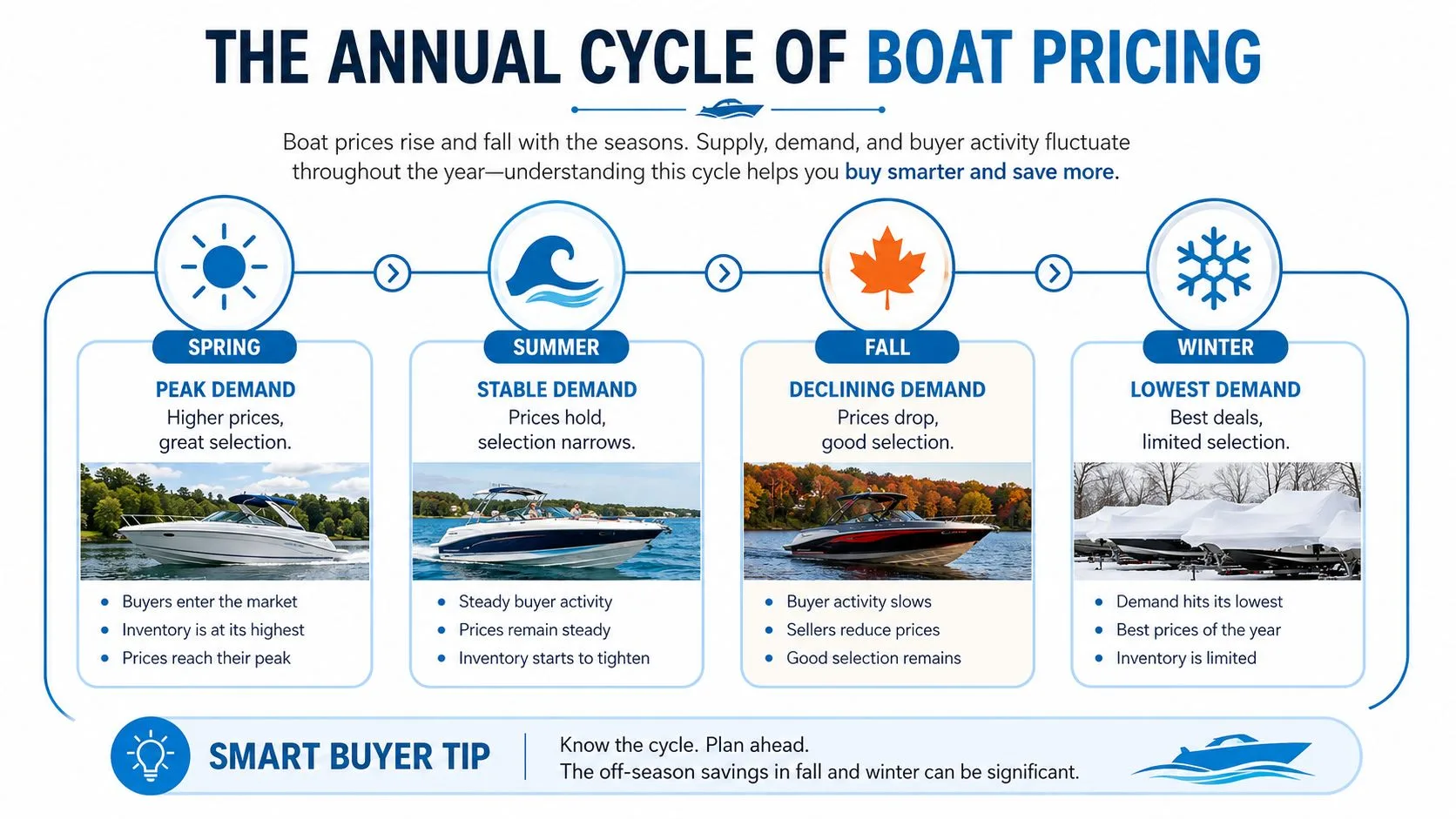
Boat pricing follows a fairly predictable annual rhythm. Once you understand that rhythm, dealer behavior starts to make a lot more sense.
Why Prices Rise and Fall
In most of the U.S., spring is when shoppers wake up and start thinking about boating again. Dealers and private sellers both know that — more buyers means firmer pricing and less pressure to negotiate. By summer, demand is still strong and many buyers become less price-sensitive since they want immediate use, which is one reason summer is widely seen as the worst time to buy.
Fall is where the market changes direction. According to One Marine's overview of seasonal boat market timing, September through November is consistently identified as the prime buying season, since sellers want to avoid winter storage costs and buyers face much less competition.
Winter usually pushes that trend further — demand gets even quieter, giving buyers more negotiating power. The trade-off is simple: as the season gets colder, inventory often gets thinner.
What Dealers and Private Sellers Are Solving For
Dealers and private sellers aren't reacting to the same pressures, and that difference changes how you should negotiate with each.
| Seller Type | Main Pressure | What Usually Works |
|---|---|---|
| Dealer | Carrying unsold inventory and making room for new stock | Ask about leftover inventory, incoming model-year units, and how long the boat has been listed |
| Private seller | Avoiding off-season costs and hassle | Offer a simple transaction, move quickly, and stay focused on condition and paperwork |
Sellers don't discount boats because the leaves changed color. They discount when holding the boat becomes more expensive or more annoying than selling it.
For a first-time buyer, that's the inside baseball: seasonal timing matters, but seller pressure is what actually creates the deal.
Best Months to Buy for Price vs. Selection
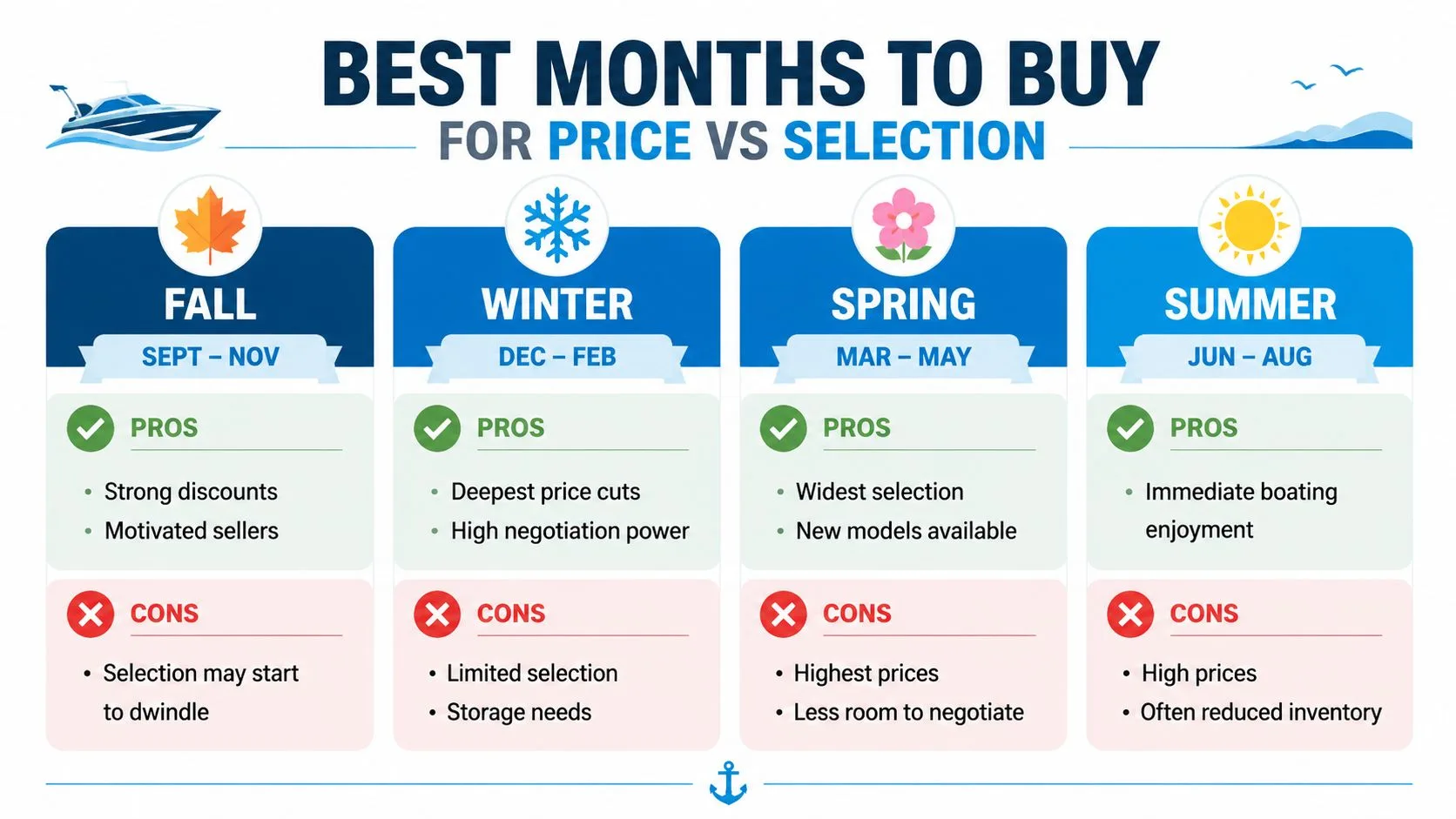
The best month isn't always the best buying window. Some buyers need the lowest price. Others need enough inventory to compare layouts, seating, storage, and onboard features without settling.
Fall Works for Most First-Time Buyers
If you want the best balance, buy in fall. It's usually the cleanest answer for beginners — you still have meaningful selection, but the emotional urgency has left the market.
BoardCo's seasonal buying guide describes fall, from mid-August through December, as the best combination of pricing, rebates, and selection, with October offering the best balance of incentives and dealer motivation. That lines up with what many buyers experience — dealers want aging inventory gone, and private sellers are less interested in carrying a boat into storage season.
For buyers who want one month to circle on the calendar, Seattle Laser Fleet's write-up on the cheapest month to buy a boat says October is often the single cheapest month in the U.S., with potential discounts of 20% to 40% compared to summer prices.
Value-focused families
You want a good recreational boat without paying spring pricing.
First-time shoppers comparing layouts
There are still enough options to learn what fits your crew.
Used-boat buyers
Sellers often become more flexible before winter costs hit.
Winter Brings the Lowest Demand and Harder Trade-Offs
Winter can be excellent for pure savings, especially on new boats and quiet dealer inventory. According to Boating Valley's winter pricing breakdown, new boats are 5% to 13% cheaper in winter (specifically November through February), with an average discount of about 8%. That same source notes category-specific winter savings on some common boat types, including pontoons, bass boats, skiffs, and jet boats.
That sounds great, and often it is — the catch is inventory. By deep winter, some of the most attractive leftovers are already gone, and you may need to compromise on color, electronics package, seating layout, or trailer setup.
Winter is strongest when you're flexible on features and patient about launch timing.
Spring Gives You Choice, Not Leverage
Spring is where many first-time buyers start shopping, which is exactly why it isn't usually the best time to buy on price. Inventory tends to look better and new model-year boats are visible, but you're shopping when everyone else is too — so dealers and private sellers have less reason to bend.
Spring is the right window for buyers who care more about exact fit than savings — a family that needs a specific seating arrangement, a wake-focused buyer who wants a particular ballast and tower setup, or an angler who wants a specific deck layout before the season begins.
Summer Is for Immediate Use, Not Bargains
Summer is easy to understand — you can buy a boat and use it right away. The downside is pricing power, or the lack of it. Even in a softer overall market, summer still tends to be the least buyer-friendly season, because the strongest natural motivation to buy is already in play.
If you're a first-time buyer, summer is where rushed decisions happen. Inventory can look tempting, but urgency hides flaws, and it makes buyers overlook practical issues like tow vehicle limits, driveway storage, or whether a pontoon, deck boat, or bowrider actually fits the water they use most.
How Region and Boat Type Affect Your Timing
National advice helps, but boat buying is local — the same month can feel very different in Minnesota than it does in Florida.
Cold inland market
Wait for off-season pressure and negotiate hard.
Warm coastal market
Shop later into winter, but don't assume every seller is desperate.
Cross-region shopping
Sometimes it's worth looking outside your immediate area if your local market stays firm.
In colder regions, the off-season is more defined — once temperatures drop, the local buyer pool shrinks fast, often creating stronger end-of-season pressure on both dealers and private sellers. Warm coastal markets are different: YATCO's guide to the best time to buy a boat notes that in places like Florida, where boating happens year-round, the best buying window can stretch into late winter, but prices generally start rising in March as spring demand builds. The off-season still matters there — it just doesn't hit as hard or as early.
Boat type matters too. A family looking at a pontoon or bowrider usually enters the market in spring, right when leisure demand is strongest. A buyer targeting a center console in a coastal market may find a longer active selling season, and a shopper looking for a wake or surf boat may care more about model-year features and factory-order timing than a used aluminum fishing boat buyer would. If you're still deciding between categories in the first place, timing shouldn't be your first decision — fit should be. Buying a cheap boat in the right month doesn't help if it's the wrong type for your water, passengers, towing setup, or storage situation.
Strategic Timing for New vs. Used Boats
New and used boats follow different timing logic — that's where a lot of first-time buyers mix signals.
For a New Boat, Order Timing Matters
If you're buying new, don't only think about what's sitting on the lot — think about when to order. This discussion of fall boat ordering strategy points to a contrarian move many first-time buyers miss: ordering in October or November can provide factory rebates of 5% to 15% while giving you customization options that often fade by spring. That's different from buying whatever is left over: you're using the dealer's pre-show and end-of-year motivation to get terms that may not be available once spring demand returns. This works especially well if you already know your use case and want a specific configuration — a family that wants a pontoon with the right seating and storage layout, a watersports buyer who wants a certain tower package, or a fishing buyer who cares about electronics placement more than immediate delivery.
Another path is shopping leftover new inventory. The risk is lower than a custom order, since you can inspect the actual boat, but the choice is narrower.
For a Used Boat, Seller Pressure Matters More
With used boats, condition and seller motivation usually matter more than model-year timing. The strongest used-boat opportunities often come from sellers who don't want to store, winterize, transport, or maintain the boat through the off-season — which is why fall and early winter are so productive for used buyers. A clean, simple offer can matter almost as much as the number itself.
Before you get serious on any pre-owned boat, use a proper used boat inspection checklist. First-time buyers often focus on upholstery and shiny gelcoat, while the expensive problems sit elsewhere:
- Hull and structure: look for damage, poor repairs, soft spots, or signs of impact.
- Engine and systems: cold start behavior, service records, corrosion, wiring, bilge condition.
- Trailer condition: tires, brakes, bunks, lights, and frame rust.
- Paperwork: title, registration, hull identification number, and lien status.
If you're buying used, the best deal isn't the lowest asking price — it's the cleanest boat with the fewest hidden problems at a fair off-season number.
Not Sure Which Type Fits You Yet?
Timing matters, but the wrong boat at the right price is still the wrong boat. Take our free 2-minute quiz and get matched to the type that actually fits your crew, water, and budget.
Take the Boat Finder Quiz →Beyond the Calendar: Other Key Buying Opportunities
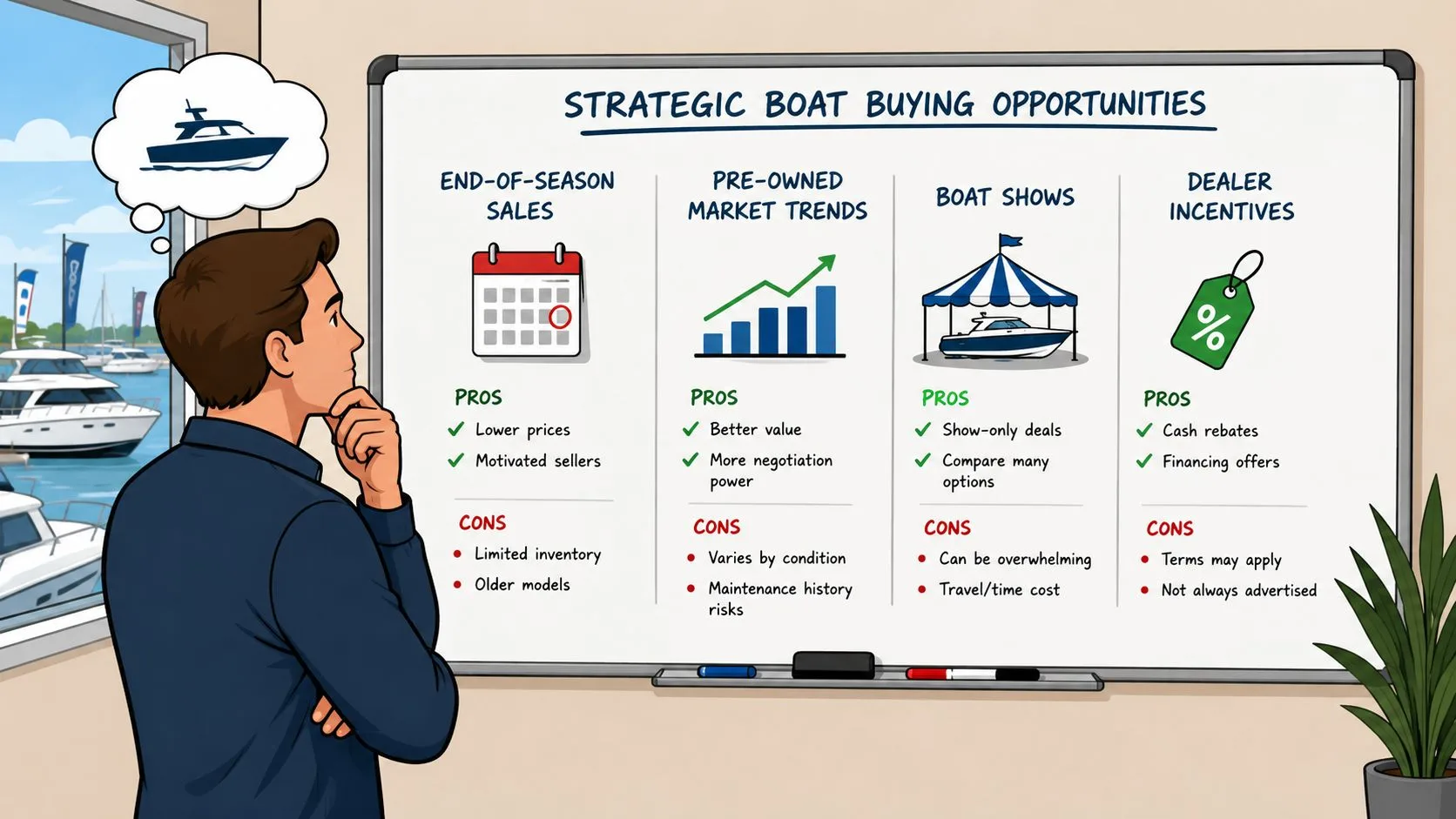
Seasonality matters, but the best time to buy a boat isn't always tied to the month — sometimes the better move is spotting a seller-specific opportunity.
Aged Inventory Is Where Negotiation Gets Real
A boat that has sat on a dealer lot for a long time can be more interesting than a fresh listing in the "right" month. According to Find a Boat's analysis of seasonal discounts and aged inventory, boats listed for 90+ days cost dealers an estimated $300 to $600 per month in floor plan interest and tend to be 10% to 15% more negotiable than fresh listings — one of the more useful pieces of pricing logic for a first-time buyer to understand.
Here's how to use it without overcomplicating things:
- Watch time on market: a stale listing deserves more attention than a brand-new one.
- Track price changes: repeated reductions usually signal growing dealer motivation.
- Ask direct questions: "How long has this boat been here?" is a simple, useful one.
- Compare against similar inventory: if one boat keeps sitting while comparable ones move, find out why.
Aged inventory isn't automatically a good boat — sometimes it sits because the layout is odd, the price started too high, or the condition is weaker than the photos suggest. But when the boat is sound, time on the lot can provide a real advantage.
Use Boat Shows Carefully
Boat shows can help, but they also trigger rushed decisions — they tend to create short-term demand spikes and put buyers in a comparison-heavy, high-pressure environment. A smart buyer uses a boat show for three things, then goes home and thinks it over:
- Hands-on comparison of layouts, sizes, and types.
- Pricing reconnaissance to see what incentives are being discussed.
- Dealer screening to identify who is prepared, transparent, and easy to work with.
Boat shows can be a good time to gather quotes or compare a pontoon against a deck boat, or a center console against a dual console. They're a weaker time to make a same-day emotional purchase unless you've already done your homework.
A Practical Timeline for Your First Boat Purchase
Good timing doesn't help if your process is sloppy. Most first-time buyers do better when they treat the purchase as a sequence instead of a single shopping trip.
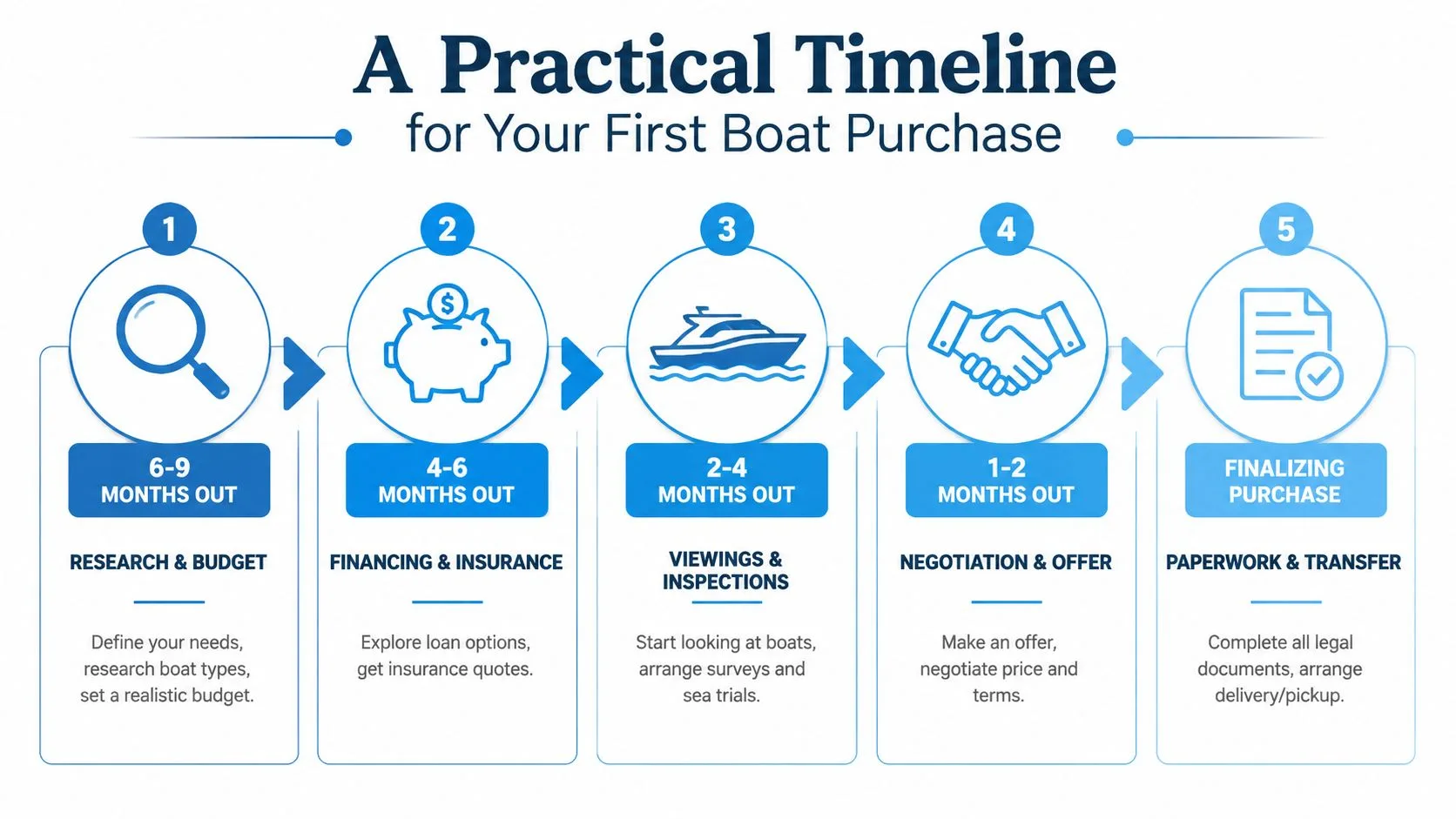
6–9 months out
Define the mission first. How many people are you carrying? Are you cruising, fishing, tubing, or mixing all three? Where will you boat, and what will tow and store it?
4–6 months out
Get realistic on financing, insurance, storage, and ongoing costs. This is also when you narrow your boat type and acceptable size range.
2–4 months out
Start watching listings seriously. Compare layouts, engine hours on used boats, and trailer condition. Line up inspections and sea trials when needed.
1–2 months out
Make offers when your target window opens — for many buyers, that's fall or winter. Be ready with paperwork, deposit funds, and a clear list of firm requirements.
Final steps
Close carefully. Confirm title and registration details, equipment included in the sale, trailer paperwork if applicable, and delivery or pickup logistics.
A written process keeps you from skipping important steps in the excitement of finding a boat. If you want a practical worksheet to use while shopping, keep our boat buying checklist handy.
The Simple Version
Buy in fall if you want the best blend of price and choice. Push into winter if price matters most and you're flexible. Move earlier only when you need a specific setup or want to be on the water immediately. Whenever you buy, make sure it's the right type of boat first.
Find My Perfect Boat